Late Talkers and Speech Delay in Toddlers: When to Wait and When to Get Help
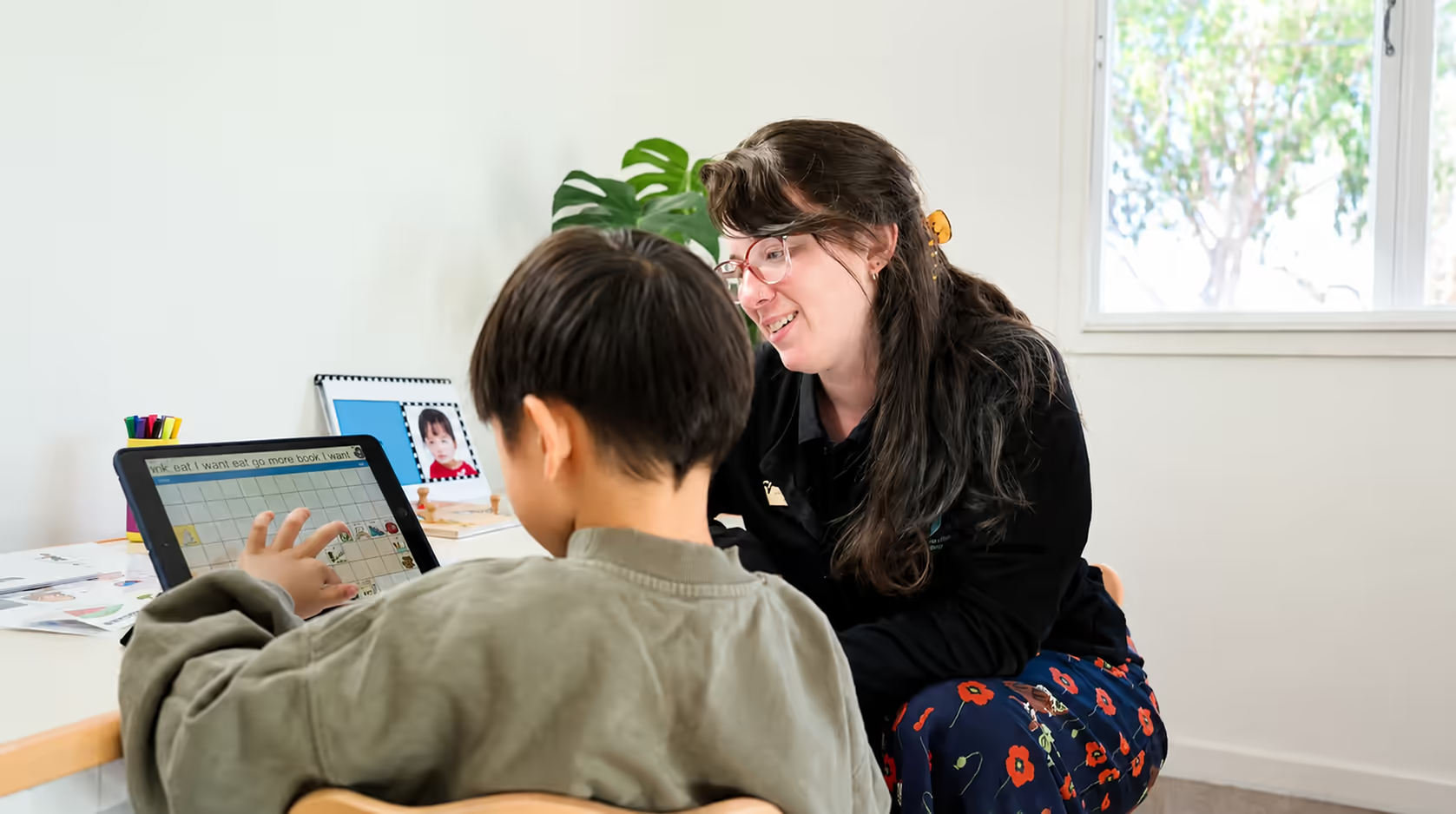
A late talker is a toddler who starts to use words later than other children the same age, with no known cause such as hearing loss or autism. Talking later is common, and many late talkers catch up. But no one can tell at age 2 which children will catch up and which will need help, so if you're worried, it's worth getting your child's talking checked.
This guide covers the talking milestones Australian health services use and what research says about late talkers. It also covers the signs that mean you shouldn't wait, and what happens at a speech assessment for a toddler.
What is a late talker?
Speech Pathology Australia describes late talkers as toddlers who are late to begin talking and using words, with no known cause such as an intellectual disability or autism. A late talker may reach age 2 using fewer than 50 words, or only a few word combinations. Some late talkers also find it hard to understand words, sentences and instructions.
Late talking is common. Two large Australian studies found that about 1 in 8 two-year-olds in Western Australia and almost 1 in 5 in Melbourne were late talkers. Toddlers also vary a lot: in the Melbourne study, 2-year-olds used 261 words on average, but some used 600 words and some used none.
Late talker, speech delay or language delay: what's the difference?
These terms are often mixed up, but they mean different things:
- Speech is saying sounds clearly. A speech difficulty means a child has trouble making speech sounds, so they can be hard to understand.
- Language is understanding words and sentences (receptive language) and using them to share ideas (expressive language). A language delay means difficulty with one or both.
- A late talker mainly has an expressive language delay: they are slow to start using words, even if they understand well.
People often say "speech delay" when they mean a late talker. A speech pathologist can work out which kind of difficulty your child has.
Communication milestones from 12 months to 5 years
These milestones from Speech Pathology Australia show what children can usually do at each age. Children vary, so use them as a guide.
- 12 months: understands about 10 words and responds to their name. Uses sounds and gestures, says a few words, and still babbles.
- 18 months: understands up to 50 words and some short phrases, and follows simple instructions like "throw the ball". Points to familiar things when they're named, and says 6 to 20 single words.
- 2 years: says more than 50 single words and puts two words together, like "no ball". Follows two-part instructions. About half of what they say should be understood.
- 3 years: says four to five words in a sentence and asks "what", "where" and "who" questions. Family and friends should understand most of what they say.
- 4 years: uses words like "and", "but" and "because" to make longer sentences, and describes recent events.
- 5 years: follows three-part instructions and uses well-formed sentences that most people can understand. May still find sounds like s, r, l and th hard.
Our article on signs your child may benefit from speech therapy covers other things to look out for.
Why milestone lists don't all agree
If you've looked at a few websites, you may have seen different numbers. At 18 months, for example:
- Speech Pathology Australia says children usually say 6 to 20 single words.
- Healthdirect says children use about 50 words between 18 months and 2 years.
- Raising Children Network says toddlers might know and use 20 to 100 words by 18 months.
- Children's Health Queensland's milestones checklist says at least three words besides names. Its checklists show what 75% or more of children can do, so they are a point to seek advice, not an average.
An average is not a cut-off, and one number doesn't tell you much about your child. Look at the signs below, and trust your own sense that something isn't right.
Do late talkers catch up? What Australian research says
Australian studies have followed late talkers for years:
- In the Early Language in Victoria Study in Melbourne, almost 70% of late talkers had typical language by age 4. But more than 7% of children who were talking on time at 2 had low language at 4.
- In a Western Australian study, 80% of late talkers were back on track by age 7. Still, about 1 in 5 late talkers had language difficulties at school age, compared with about 1 in 10 other children.
- In the Western Australian Raine Study, late talking at age 2 was not linked to behaviour or emotional problems later in childhood and adolescence.
Raising Children Network says most late talkers have caught up by age 4. The hard part is that researchers can't reliably predict at age 2 which children will. One useful early clue is how well a child understands language, not just how many words they say.
Wait and see, or get help?
Speech Pathology Australia advises getting a professional opinion early rather than waiting to see, because it's hard to tell which toddlers will have ongoing difficulties. Children's Health Queensland's checklists say "Don't wait. Act early" if a child hasn't met a milestone for their age or shows a warning sign. The Royal Children's Hospital in Melbourne notes that late talking often resolves between ages 2 and 4, but advises careful monitoring.
Getting a check doesn't commit you to therapy. After an assessment, the next step might be therapy, ideas to try at home, a referral, or a review later on.
Signs that mean you shouldn't wait
Talk to a speech pathologist, your GP or a child health nurse if your child:
- doesn't respond to their name or to sounds;
- isn't trying to communicate with babbling, words or gestures by 12 months;
- isn't saying any single words, or isn't pointing, waving or using other gestures, by 18 months;
- doesn't follow simple instructions, like "give me the ball", by 18 months;
- isn't saying about 50 words or putting words together by 2;
- is using gestures and grunts in place of words;
- is often hard to understand for you, family or friends by 3;
- stops doing things they used to do, such as talking, at any age.
Get advice too if you have strong concerns, even if none of these signs apply. If your child loses words or other skills they used to have, see your GP.
Boys are about three times as likely as girls to be late talkers, and a family history of language difficulties is more common in late talkers. But neither reliably tells you whether a late talker will catch up, so neither is a reason to wait.
First steps: a hearing check and your GP or child health nurse
Check hearing first. The Royal Children's Hospital recommends a hearing assessment for any child with a language delay. Repeated middle ear infections and glue ear can delay speech, and they can be treated. Children's Health Queensland runs free community hearing screening for eligible children from 9 months to 16 years, with no referral needed. Clinics near Brisbane's southside include the Mount Gravatt Child Health Service and Inala Community Health Centre.
Talk to a child health nurse or your GP. The Child Health Service run by Children's Health Queensland is free for families with children from birth to 8. You can also call 13 HEALTH (13 43 25 84) and ask to speak to a child health nurse at any time of day. You don't have to wait for a scheduled check in your child's red book (Personal Health Record) to raise a concern.
You can also book a speech pathologist directly, without a referral.
What happens at a speech assessment for a toddler
A speech assessment for a toddler usually includes:
- Questions for you about pregnancy and birth, milestones such as first words, health and hearing, and what your child finds hard.
- Play. Much of the assessment looks like play, so the speech pathologist can see how your child understands, uses gestures, plays and makes sounds.
- Simple tasks or tests, such as pointing to pictures or following instructions. Some speech pathologists also use a checklist of the words your child says.
- A quick look at your child's lips, teeth and tongue.
- Next steps. The speech pathologist explains what they found and what they suggest, such as therapy, home activities, a hearing test or a review later.
Sometimes an assessment takes more than one session. It helps to bring your child's red book, any reports from a hearing test or paediatrician, a list of the words and gestures your child uses, and your questions. You can read what a first speech assessment looks like at our Runcorn clinic on our service page.
Does therapy help late talkers? An honest look
One well-studied approach for young children is coaching parents to use language-building strategies in everyday talk and play. Reviews of studies with toddlers and preschoolers who have language difficulties find positive effects, mostly on what children say. Effects on understanding are smaller or less clear.
A Melbourne trial offered a six-week group program to parents of 18-month-olds who said few words on a checklist. At age 3, these children's language was no different from children whose parents weren't offered the program. The researchers thought this was mainly because most children in both groups caught up anyway.
This is one reason an assessment looks at understanding, gestures and play, not just word counts.
Everyday ways to help your toddler talk
Speech Pathology Australia, healthdirect and Raising Children suggest you:
- get face to face, follow your child's lead, and talk about what they are doing ("going up", "feeding teddy");
- pause and wait for your child to respond before you say more;
- add a word to what your child says, so "ball" becomes "red ball";
- read together, and talk about the pictures that interest your child;
- avoid testing them with questions like "what's this?";
- repeat words the right way, rather than telling them they said it wrong;
- limit screen time, so there is plenty of time to talk and play together;
- keep using the language or languages you speak at home.
Paying for an assessment and therapy
You don't need a referral to book a private speech pathologist.
- NDIS early childhood approach: for children younger than 9 with delays in their development or disability. An early childhood partner can help even if your child isn't eligible for the NDIS. This includes early supports for children younger than 6 with developmental concerns.
- Thriving Kids: a new program for children aged 8 and under with developmental delay or autism and low to moderate support needs. As at late October 2026, the federal Thriving Kids website did not list any services for Queensland.
- Medicare: some speech pathology is covered for people under 25 with a doctor's referral, for conditions such as autism, speech sound disorders and stuttering. Late talking on its own is not covered. Your GP can tell you whether your child qualifies.
Our guide to what speech therapy costs and how to pay for it explains the options in more detail.
Speech pathology for toddlers at Queensland Therapy Center
Our paediatric speech pathologists work with children from age 2. Families often get in touch because their child is talking later than other children, and it is worth checking early rather than waiting to see. For young children, much of our assessment happens through play, and at the end we talk through what we found and suggest next steps.
We see children at our clinic in Runcorn, or at home or kindy across Brisbane's southside. Our team includes Certified Practising Speech Pathologists, and we support families through the NDIS. You don't need a referral to book with our speech pathologists in Runcorn, and you can contact us with any questions. For children under 2, your GP or child health nurse is a good first step.
Frequently asked questions
Is it normal for a 2-year-old not to talk much?
Children vary a lot. In a Melbourne study, 2-year-olds used 261 words on average, but some used none. By 2, most children say more than 50 words and put two words together. If your child doesn't, it's worth getting advice.
How many words should an 18-month-old say?
Speech Pathology Australia says children usually say 6 to 20 single words at 18 months. Other sources give different numbers. How well your child understands, and whether they use gestures like pointing, matter as much as word counts.
When should I worry about speech delay?
Get advice if you notice any of the signs above, or if you're worried for any reason.
Is late talking a sign of autism?
Speech Pathology Australia describes late talkers as children who talk late with no known cause, such as autism. Some signs do need a check, such as not responding to their name, limited eye contact, few gestures, or losing skills, so talk to your GP or paediatrician. Our article on speech therapy for autism explains how speech pathologists support autistic children.
Do boys talk later than girls?
Boys are about three times as likely to be late talkers, but being a boy doesn't predict who will catch up. Don't wait just because your child is a boy.
Does learning two languages cause speech delay?
Children in bilingual families might seem to learn language more slowly, and Raising Children notes this isn't considered language delay. Keep using your home languages, and get advice if you're worried about all of them.
Sources
- Speech Pathology Australia: late talkers, communication milestones, the sound of speech: 0 to 3 years, Medicare expansion for speech pathology.
- healthdirect: speech development in children, developmental milestones, speech pathology.
- Raising Children Network: language delay, language development at 1 to 2 years and 2 to 3 years, speech pathologist.
- Children's Health Queensland: Child Health Service, twelve questions that can change a child's life, milestones checklists for child development, community hearing screening clinics, Personal Health Record (red book).
- Royal Children's Hospital Centre for Community Child Health: Community Paediatric Review, volume 23, number 3 (2015). Telethon Kids Institute: toddler talk (2013). NSW Health, Western NSW Local Health District: visiting a speech pathologist.
- Reilly S et al. Pediatrics, 2010. Zubrick SR et al. Journal of Speech, Language, and Hearing Research, 2007. Rice ML et al. Journal of Speech, Language, and Hearing Research, 2008. Whitehouse AJ et al. Pediatrics, 2011. Fisher EL. Journal of Speech, Language, and Hearing Research, 2017. Wake M et al. Let's Learn Language trial. BMJ, 2011. Levickis P et al. Journal of Developmental and Behavioral Pediatrics, 2014. Roberts MY, Kaiser AP. American Journal of Speech-Language Pathology, 2011. Heidlage JK et al. Early Childhood Research Quarterly, 2020.
- NDIS: early childhood approach. Department of Health, Disability and Ageing: about Thriving Kids, Thriving Kids in states and territories. Medicare Benefits Schedule: note MN.10.3.
Written by Wenjin Zhang, Clinic Director, Board Certified Behavior Analyst and Certified Practising Speech Pathologist. Last updated October 2026. General information only, not advice for your situation.
Get Support
Ready to take the next step?
Our team is here to help. Book a session or reach out with any questions.
Contact Us

Appointment
Ready to book your first session?
We'd love to hear from you. Whether you have questions or you're ready to get started, just reach out — we're here to help.