NDIS Support Worker Rates 2026-27: A Guide for Participants and Families
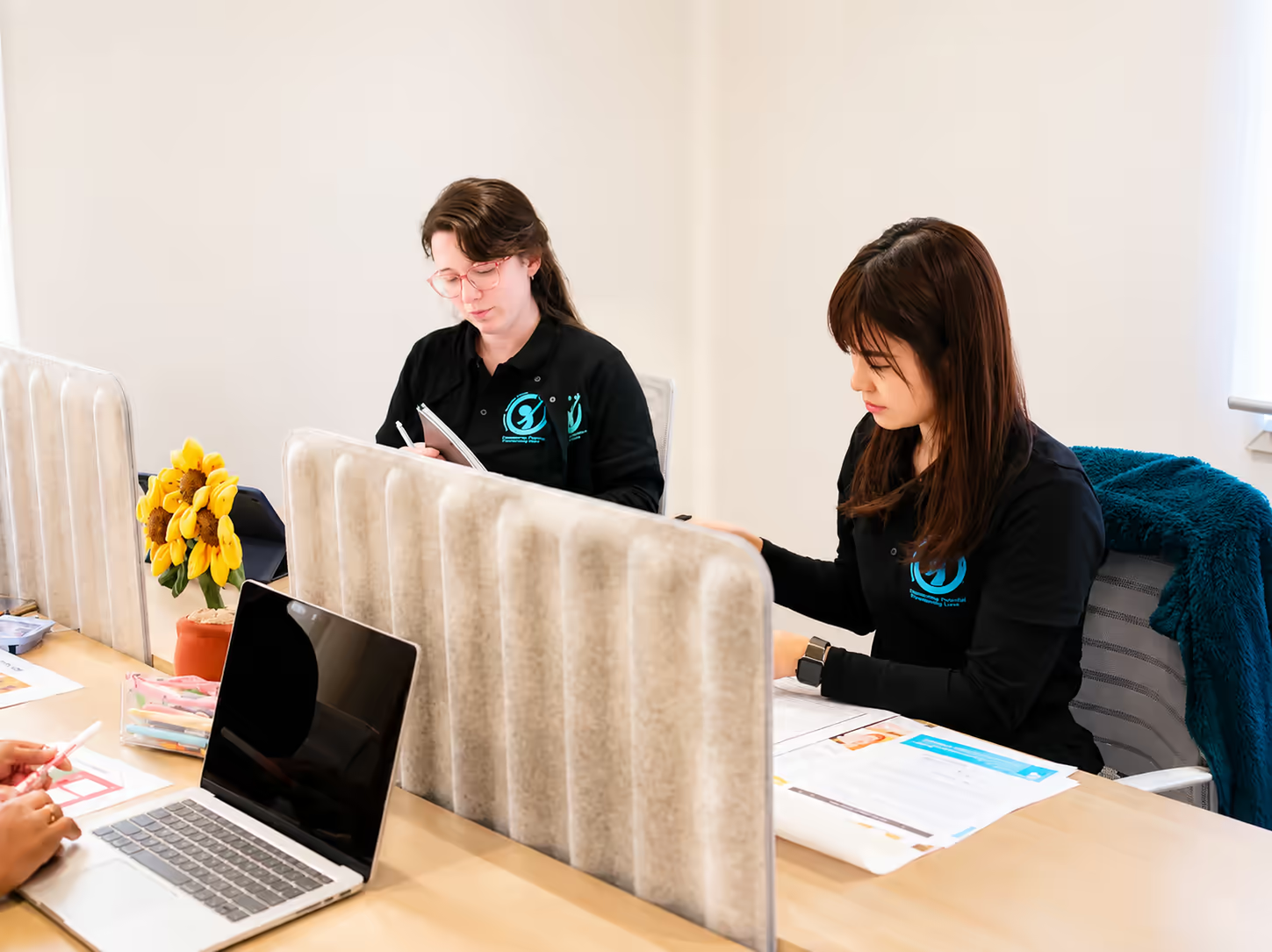
NDIS support worker rates are the maximum prices a provider can charge for a support worker's time when your NDIS funding is NDIA-managed or plan-managed. For 2026-27, standard support on a weekday during the day costs up to $73.58 an hour in Brisbane and other cities. Evenings, weekends and public holidays cost more.
This guide for participants and families explains the current rates, who they apply to, why prices vary, where the money goes, and what to check with a provider. All 2026-27 prices come from the official NDIS pricing schedule, checked on 15 October 2026.
Where NDIS support worker rates come from
Since 24 September 2026, NDIS maximum prices have been set by the Minister for the NDIS in a pricing determination, after advice from the NDIA. The prices are listed in the NDIS Pricing Schedule 2026-27. Until 30 June 2026, the NDIA published them in the NDIS Pricing Arrangements and Price Limits, which many people still call the NDIS price guide.
The prices did not change on 24 September. The NDIA says they reflect the guidance it published in June 2026, which applied from 1 July, and that participants and providers don't need to do anything. The standard weekday daytime price rose by about 4.8% this year, from $70.23 in 2025-26 to $73.58, in line with the Fair Work Commission's minimum wage decision.
NDIS support worker rates for 2026-27
These are the maximum prices for standard support from one support worker, such as help with personal care or getting out into the community (Disability Support Worker Level 1 in the schedule). They are national prices, which apply in Brisbane and most areas classed MM 1 to 5 under the Modified Monash Model (a few isolated towns are priced as remote).
- Weekday daytime (6 am to 8 pm): $73.58 an hour
- Weekday evening (8 pm to midnight): $81.07 an hour
- Weekday night: $82.57 an hour
- Saturday: $103.54 an hour
- Sunday: $133.50 an hour
- Public holiday: $163.46 an hour
- Night-time sleepover: $311.79 for the night
The same prices apply to the main personal care items (Assistance With Self-Care Activities, for example item 01_011_0107_1_1 on a weekday daytime) and, for daytime, evening, weekend and public holiday support, the main community access items (Access Community Social and Rec Activities, for example item 04_104_0125_6_1).
All prices include any GST. Hourly prices are worked out by the minute, so half an hour on a weekday daytime is up to $36.79.
Who the maximum prices apply to
How your plan is managed decides whether the maximum prices apply to you.
- NDIA-managed: the maximum prices apply, and you must use registered providers.
- Plan-managed: the maximum prices apply, including when you choose an unregistered provider. Your plan manager can't pay more than the maximum.
- Self-managed: the maximum prices don't apply. You can agree on a price above or below them, and you can employ or contract workers directly. You still need to spend in line with your plan and make your funding last.
A maximum price is a ceiling, not a set fee. You and your provider can agree on a lower price. In practice, most claims are made at the maximum: the NDIA's latest pricing review found that 69% of claims for support worker supports between July and December 2025 were made at the published price.
Every NDIS provider and worker, registered or not, must also follow the NDIS Code of Conduct, which says they must not charge NDIS participants higher prices without a reasonable justification. The NDIS Commission explains that pricing is fair when there is no major difference between the price for a participant and for other customers.
Why the same hour can cost different amounts
Time and day. A weekday daytime support starts at or after 6 am and finishes by 8 pm. A weekday evening support starts at or after 8 pm and finishes by midnight. A weekday night support runs past midnight, or starts before 6 am. Saturday, Sunday and public holiday prices apply from midnight to midnight.
Shifts that cross a boundary. If one worker's shift crosses from one time band or day into another, the higher price applies to the whole shift. For example, a 6 pm to 9 pm shift on a Tuesday crosses into the evening, so all 3 hours can be charged at up to $81.07, a total of $243.21. Finishing at 8 pm keeps the whole shift at the daytime price.
Public holidays. The schedule lists New Year's Day, Australia Day, Good Friday, Easter Monday, Anzac Day, the King's Birthday, Christmas Day and Boxing Day, plus any other day declared a public holiday in the state or territory where the support happens.
Sleepovers. A night-time sleepover is a shift of 8 hours or more that runs across midnight, where the worker can sleep when they are not needed. It has one price for the night. If the worker gives more than 2 hours of active support, the provider may also charge for the third and later hours, at the Saturday price on weeknights (or that day's price on weekends and public holidays).
More complex support. Some people need a worker trained in high intensity supports, such as complex bowel care, tube feeding or catheter care, or need intensive and complex behaviour support. This is Level 2, at up to $79.60 an hour on a weekday daytime and $144.42 on a Sunday. Some skill-building supports, such as Individual Social Skills Development and Training For Carers/Parents, are Level 3, at up to $83.87 an hour. Psychosocial recovery coaching is Level 4, at up to $110.44 an hour on a weekday daytime.
Location. Prices are higher in remote areas (MM 6, up to $103.01 on a weekday daytime) and very remote areas (MM 7, up to $110.37), including some isolated towns the NDIA has reclassified. The place where the support happens decides the price, not your home address.
Groups. When one worker supports a group, each person can be charged the hourly price divided by the number of people. In a group of 3 on a weekday daytime, that is about $24.53 an hour each. When a group or centre-based community activity is delivered at a centre, the provider can also claim a centre capital cost of up to $2.71 an hour for each person.
Where the money goes
The hourly price is not the worker's pay. The NDIA's Disability Support Worker Cost Model 2026-27 shows how it builds the $73.58 standard weekday price:
- base pay of $38.50 an hour, for a level 2.3 worker under the SCHADS Award from 1 July 2026;
- leave, superannuation at 12% and allowances, which bring the cost to $52.94 for each hour worked;
- workers compensation, supervision and time that can't be billed, which bring it to $64.41;
- running the business, such as accounting, human resources and IT, which brings it to $72.13;
- a 2% margin, for a total of $73.58.
So in this model, about half the hourly price is the worker's base pay. The rest pays for the costs of employing and supporting them.
Other charges to check in your service agreement
The 2026-27 schedule lists prices, and the NDIA has said it will publish updated pricing and claiming guidance. Until it does, ask your provider to set these out in writing:
- Travel: whether they charge for the worker's travel time or kilometres, and how much.
- Cancellations: how much notice you need to give, and what you pay if you cancel late.
- Establishment fee: the schedule lists an establishment fee of up to $735.80 for personal care and community participation supports. Ask whether it applies to you.
- Activity costs: for social and community activities, the NDIS may fund the worker's time, but you usually pay the costs anyone pays, such as entry fees, tickets and memberships.
The NDIS recommends a service agreement that says what supports you'll get, how they are provided, what they cost, how the provider is paid, and what to do if something goes wrong.
How far your budget goes
At the maximum prices:
- 10 hours a week on weekdays during the day costs up to $735.80 a week, or $38,261.60 over 52 weeks.
- A 4-hour outing costs up to $294.32 on a weekday, $414.16 on a Saturday and $534.00 on a Sunday.
- $10,000 of funding pays for just under 136 hours of weekday daytime support, just under 97 hours on Saturdays, or just under 75 hours on Sundays.
Moving a regular shift from Sunday to a weekday can stretch your budget a long way. Agreeing on a price below the maximum stretches it further.
Changes coming in late 2026 and 2027
- Smaller budgets for community participation. For plans created or reassessed from 1 October 2026, or renewed from 1 February 2027, funding for social, economic and community participation supports is reduced by 50%, and for improved daily living skills supports by 10%. Standard community access support worker items sit in the first group. Everyday help such as eating, dressing, toileting, cleaning and laundry is not affected, and nor are high intensity supports. The prices stay the same; the budget changes. Our guide to what a support worker does explains this in more detail.
- A 90-day limit on claims. From 1 December 2026, participants and plan managers will need to make claims within 90 days of the support being delivered, down from 2 years. Ask providers to send invoices promptly.
- Possible price updates. The Fair Work Commission has decided changes to part of the SCHADS Award, which take effect on 1 December 2026. The government has said the pricing schedule will be updated later this year to reflect any required changes.
- Different prices for unregistered providers (proposed). The government is consulting on differentiated pricing, which would set prices based on whether a provider is registered or unregistered. The NDIA's pricing review recommended starting on 1 January 2027, with a 10% lower price for unregistered providers of social, community and civic participation supports. As at mid-October 2026, this had not been confirmed.
- Your say on next year's prices. Consultation on the pricing review for 2027-28 is open on NDIS Engage until 1 November 2026.
Our article on NDIS funding for autism covers the other 2026 changes to plans.
Questions to ask a provider about price
When you talk to a provider, including our NDIS support workers in Brisbane, these questions help you compare:
- Which support item will you claim, and at what price?
- Do you charge the maximum price, or less?
- What do you charge for travel and for late cancellations?
- Will you charge an establishment fee?
- Is there a minimum shift length?
- How will shifts that cross 8 pm or midnight be charged?
- How soon after each shift will you send an invoice?
- Will your prices change if the pricing schedule is updated?
Support workers at Queensland Therapy Center
Queensland Therapy Center is a registered NDIS provider in Runcorn, on Brisbane's southside. We work with participants whose plans are NDIA-managed, plan-managed or self-managed.
Our community support workers help with household tasks, personal care, life skills such as using transport, cooking and budgeting, getting to appointments and running errands, and taking part in community activities. For NDIA-managed and plan-managed participants, prices can't be more than the maximum prices in the NDIS pricing schedule.
Contact our team to ask about the current rate for the support you need and how it would be claimed. Tell us where you live, and we'll confirm whether we can provide support workers in your area. Support coordinators can use our referral form.
Frequently asked questions
What is the NDIS hourly rate for a support worker in 2026?
For standard support on a weekday during the day, the maximum is $73.58 an hour in 2026-27. This is the national price, which applies in Brisbane. Evenings, weekends and public holidays are higher.
What is the NDIS Sunday rate for support workers?
Up to $133.50 an hour for standard support, and up to $144.42 an hour for high intensity support.
Can a provider charge more than the NDIS price limit?
Not if your plan is NDIA-managed or plan-managed. If you self-manage, you can agree on a price above the maximum, but it comes out of the same budget.
Is the pricing schedule the same as the NDIS price guide?
It does the same job. Older versions were called the NDIS Price Guide and then the NDIS Pricing Arrangements and Price Limits. From 1 July 2026, the NDIA's guidance was called the NDIS Pricing Schedule, and since 24 September 2026 the schedule is set by the Minister's pricing determination.
Do registered and unregistered providers have different prices?
Not at the moment. When your plan is plan-managed, the same maximum prices apply to both. Lower prices for some unregistered providers have been proposed, but not decided.
How much does an NDIS support worker get paid?
It depends on their award level, how they are employed and their employer. The NDIA's cost model assumes base pay of $38.50 an hour for a standard support worker in 2026-27. The Fair Work Ombudsman publishes the award pay rates.
Sources
- NDIS: NDIS Pricing Schedule 2026-27 (effective 24 September 2026; Part 1, Appendix 1 Tables 1 to 4, Appendix 2 Table 6, Part 4), pricing arrangements, what are the NDIS pricing arrangements, pricing updates, Disability Support Worker Cost Model 2026-27, Annual Pricing Review for 2026-27 prices, NDIS Pricing Arrangements and Price Limits 2025-26, self-managed funding, plan-managed funding, how to find and choose a provider, service agreements, changes to support budgets from 1 October, new price limits set for NDIS supports, social and recreation supports.
- NDIS Quality and Safeguards Commission: NDIS Code of Conduct, high intensity daily personal activities.
- Department of Health, Disability and Ageing: funding changes for NDIS supports, about the changes to the NDIS.
Written by Wenjin Zhang, Clinic Director, Board Certified Behavior Analyst and Certified Practising Speech Pathologist. Last updated October 2026. General information only, not advice for your situation.
Get Support
Ready to take the next step?
Our team is here to help. Book a session or reach out with any questions.
Contact Us
Appointment
Ready to book your first session?
We'd love to hear from you. Whether you have questions or you're ready to get started, just reach out — we're here to help.