What Is Early Intervention? NDIS and Other Support in Queensland in 2026

Early intervention is extra support for young children whose development needs it, and for their families, given as early as possible. It can include speech pathology, occupational therapy (OT), physiotherapy or psychology, often in everyday places like home and kindy.
In Queensland in 2026, there are several ways to get it: the NDIS early childhood approach, health, kindy and community services, and the new Thriving Kids program, which is still rolling out. Some don't need a diagnosis. This guide covers each one, the research, and ideas to try at home. It is general information, as at November 2026.
What is early intervention?
Raising Children Network describes early intervention as specialised support that should start as soon as possible after a child's needs are identified. Before school, it is often called early childhood intervention.
Australia's National Best Practice Framework for Early Childhood Intervention (2025) says it is for children from birth up to 9, and their families. It covers children with developmental concerns, delay or disability. The aim is to help your child grow, learn and enjoy life, and to help your family support their development.
Early intervention can cover physical, cognitive (thinking and learning), behavioural, and social and emotional development. The NDIS says it also supports the adults in your child's life, like educators and grandparents. Good early intervention uses everyday routines and places as chances to learn, so children build skills where they will use them.
Many people dislike the word "intervention", the Framework notes, but no better term has been agreed. Our article on why early support can matter for young children looks at the early years.
Developmental concerns, delay or disability: what the NDIS words mean
The NDIS uses three terms that sound alike:
- Developmental concerns are delays in a child's development that don't meet the NDIS definition of developmental delay.
- Developmental delay means a child finds it much harder to do everyday things than other children their age. In NDIS law, it applies only to children younger than 6. The delay must come from a physical or mental impairment. It must substantially reduce what the child can do in at least one area: self-care, understanding and using language, thinking and learning, or movement. The NDIS says the child must also need specialist services from more than one professional, working as a team, for longer than 12 months.
- Disability means an impairment that is permanent or likely to be permanent.
NDIS early intervention: who can get it under the law
Under the NDIS Act, a child meets the "early intervention requirements" if, in short:
- they have developmental delay, or an impairment that is or is likely to be permanent;
- supports are likely to reduce their future need for support;
- supports are likely to help in another way, such as with communication, learning, mobility or self-care, or by helping their family keep supporting them;
- the supports are ones the NDIS funds.
Age and residence rules also apply. The test is whether support is "likely" to help, not whether it is certain to.
The NDIS law was amended in August 2026. The Australian Government says there are no changes to how people access the NDIS until 1 January 2028. From then, it says, children aged 8 and under with developmental delay, autism or both, and low to moderate support needs will no longer be eligible for the NDIS. Thriving Kids will support them instead. Children with high support needs stay eligible. Children aged 8 and under who are on the NDIS before that date keep the current rules until they turn 9, when they are reassessed.
The NDIS early childhood approach, step by step
The early childhood approach is for children younger than 9 with delays in their development or disability. Your child doesn't need a diagnosis for an early childhood partner to help. These steps are based on the NDIS page How to get help for your child and the NDIS early childhood approach guideline:
- Talk to your family doctor, child health nurse or early childhood educator.
- Contact your local early childhood partner (see the next section), or the NDIS.
- The partner gets to know your child by talking with you, reading reports, watching your child in their usual places, and using screening tools.
- Early connections. The partner can link you with local services, information and other families, even if your child isn't eligible for the NDIS. This may be all the help you need.
- Early supports. For children younger than 6 with developmental concerns, the partner may provide early supports. These usually last 3 to 6 months, and up to 12 months, with an early support plan.
- Applying to the NDIS. With evidence of an impairment that is, or is likely to be, permanent, or of developmental delay in a child younger than 6, the partner or NDIA staff can help you apply. Eligible children get an NDIS plan.
From age 9, children work with a local area coordinator instead.
Who is the early childhood partner for Brisbane and Logan?
Early childhood partners are local organisations funded by the NDIS. As at November 2026, the NDIS lists The Benevolent Society as the early childhood partner for Brisbane, Logan and Moreton Bay. The Benevolent Society's own page, and the NDIS partner map for Queensland, say it also covers Redland City.
You'll find contact details on The Benevolent Society's early childhood approach page and in the partner map on the NDIS Queensland page. If you're not sure which partner covers your area, contact the NDIS.
Thriving Kids: what it is and where Queensland is up to
Thriving Kids is a new approach to early intervention from the Australian, state and territory governments. It is for children aged 8 and under with developmental delay, autism or both, and low to moderate support needs, and their families. It started in October 2026, and all supports are due by 1 January 2028. You don't need a diagnosis or an application.
National supports open to families now, including in Queensland, are:
- an online information hub run by the Raising Children Network;
- a national phone line (or video call) to talk with a maternal and child health nurse about children aged 8 and under;
- the Thriving Kids Autism Helpline, for families with children aged 0 to 8.
The Thriving Kids supports page has contact details. Over time, states and territories will add supports such as speech pathology, OT or psychology.
As at November 2026, Queensland was not listed on the Australian Government's Thriving Kids page for states and territories. Check the current page for updates. Meanwhile, Raising Children says you can ask the NDIS for help if the supports your child needs aren't yet available through Thriving Kids. Our article on NDIS funding for autism explains more.
Help from health services outside the NDIS
Help outside the NDIS includes:
- Your GP. Raising Children suggests starting with your child's GP, paediatrician or child and family health nurse. From 1 November 2026, GPs can also do a Medicare Healthy Kids Check for 3-year-olds, once per child, which can lead to referrals for support.
- Child health nurses. Children's Health Queensland's Child Health Service is free for families with children from birth to 8, and you can ask for an appointment online. Its drop-in clinics for children up to 5 need no appointment, at sites including Acacia Ridge, Springwood, Logan Central, Browns Plains and Inala. For worries about talking, see our guide to late talkers and speech delay.
- Child Development Service. This Children's Health Queensland service sees children aged 0 to 9 in greater Brisbane with complex developmental concerns. It needs a referral from a GP, paediatrician or other medical specialist.
- Medicare for people under 25. Medicare has items for some allied health sessions, such as speech pathology and OT. They are for autism or a similar complex condition, or for a list of eligible disabilities. Since 1 March 2026, the list includes stuttering and speech sound disorders. Developmental delay and language delay on their own are not on it. A GP can refer for a listed disability, but for autism the referral must come from a paediatrician or psychiatrist. Treatment sessions need a diagnosis. See what Medicare covers for speech therapy.
Help through kindy, school and community programs
- Kindy and childcare. Ask about inclusion support. The Kindergarten Inclusion Support Scheme (for kindies) and the federal Inclusion Support Program (for long day care) may fund equipment, resources and training. The Kindergarten Inclusion Service supports kindy teachers.
- Early Childhood Development Programs (ECDPs). The Department of Education offers therapy and early intervention, from birth to before Prep, for children with a suspected or diagnosed disability and significant educational needs. Ask your regional office or local ECDP.
- Thriving and On Track (TOTs). TOTs offers developmental checks, child health nurse appointments at some centres, and help to find services, through early learning centres and community hubs in Logan and Inala. Ask your centre if you're eligible.
- Playconnect+ and ENVISAGE-Families. National playgroups for children aged 0 to 8 with disability or developmental concerns, and workshops for their parents and carers. Playconnect+ doesn't need a diagnosis.
- First 5 Forever. Free sessions at local libraries, such as Story Time and Rhyme Time.
- Triple P. Parenting programs, many of them free in Queensland, including Stepping Stones Triple P for families of children with disability.
Does early intervention work? What the evidence says
Early support can help many children, but no one can promise how much it will help any one child.
- The NDIA says early childhood intervention for young children improves long-term outcomes and usually means less support later.
- Raising Children notes that some children who get early intervention need less support, or none, as they get older.
The research has limits too:
- Autism CRC's 2022 national guideline says families should be told that no one support works equally well for every autistic child and family. It also says no one support has been shown to help with every outcome.
- Autism CRC's earlier review of autism research found that only a few of the reviews it looked at met every marker of high quality. There wasn't enough evidence to know how any one child would respond. It found no consistent evidence on whether more hours of support led to better results. Supports with parents and carers actively involved worked as well as, and sometimes better than, supports from practitioners or educators alone.
So a good reason to get help is a clear concern and a clear goal. Look for a support that suits your child and family, not one that promises a result.
How to tell whether a support is backed by evidence
It's fair to ask questions before you start. Autism CRC's guideline for autistic children says families should be told why a support is suggested and what benefits to expect, and by when. Families should also hear what it costs in money and time, and about any possible harms.
The Raising Children Network's therapies guide for autistic children rates therapies as Established, Promising, Yet to be determined, or Ineffective/harmful, based on research. For supports in an NDIS plan, the NDIS says early childhood intervention must be evidence-based.
Early intervention activities to try at home
The national families guide notes that much learning happens in everyday moments, not just in therapy. Ideas from the guide, Raising Children and Speech Pathology Australia:
- Use daily routines. Mealtimes, play and outings are chances to practise. At dinner, remind your child it's their turn to talk about their day.
- Start with strengths. Build from what your child can already do.
- Follow their lead. Get down to their level, join their play, and talk about what they're doing.
- Wait for a reply. Pause, and notice every way your child communicates: words, gestures, pictures or sounds.
- Read together, and talk about the pictures.
- Use pictures. Pictures of the morning routine, or a simple book of photos and short phrases, can help routines feel predictable.
- Play, laugh and connect.
- Look after yourself, and connect with other families.
A teacher, OT or speech pathologist may be able to help with picture supports and tailor these ideas. Read about occupational therapy for young children, including home visits in Logan, and speech pathology for young children on Brisbane's southside.
Speech pathology and OT for young children at Queensland Therapy Center
Our paediatric speech pathologists and occupational therapists work with children from age 2. For young children, much of the first assessment happens through play, and OT for children is play-based.
We see children at our clinic in Runcorn, and visit homes, schools and kindies across Brisbane's southside. You don't need a referral to book, and we support families through the NDIS. Clients without NDIS funding are welcome. Contact us before you book and we'll tell you our current rate and what it includes.
Read more about our paediatric speech pathologists in Runcorn and paediatric occupational therapy in Brisbane's south.
Frequently asked questions
What age is early intervention for?
There isn't one age. The NDIS early childhood approach is for children younger than 9, and NDIS developmental delay applies only to children younger than 6. Thriving Kids is for children 8 and under, and the national Framework covers birth up to 9.
Do you need a diagnosis for early intervention?
Not for the NDIS early childhood approach or Thriving Kids. Joining the NDIS needs evidence from a doctor, specialist or other treating professional. Medicare treatment sessions for people under 25 need a diagnosis.
Is early intervention free?
Some help is free, such as the Child Health Service, First 5 Forever and many Triple P programs in Queensland. Early connections and early supports are funded by the NDIS, and your child doesn't need an NDIS plan to get them. Private therapy has a fee, which an NDIS plan, or Medicare for eligible conditions, may help cover.
What happens when my child turns 6 or 9?
Children who joined the NDIS for developmental delay are reassessed after they turn 6. From 9, a local area coordinator takes over from the early childhood partner.
What does ECEI mean?
Early Childhood Early Intervention, the NDIS's name for the early childhood approach from 2016 until 2021. When it was renamed in 2021, the NDIS said only the name changed. You'll still see "ECEI" on some websites, including government pages.
Can my child get help while we wait for a diagnosis or the NDIS?
Yes. An early childhood partner, a Thriving Kids phone line and a child health nurse can all help without a diagnosis. So can private speech pathologists and OTs. Read about our autism support for children from age 2.
Sources
- NDIS: How to get help for your child, current as of 10 June 2026.
- NDIS: Guide to the early childhood approach, current as of 11 September 2026.
- NDIS: What is an early childhood partner, current as of 1 October 2026.
- NDIS: What are the early intervention eligibility requirements, current as of 9 June 2026.
- NDIS: Queensland, current as of 14 August 2026.
- NDIS: Our Guideline: Early childhood approach (PDF), dated 2 September 2026.
- NDIS: Our Guideline: Early connections (PDF), dated 15 December 2025.
- NDIS: New early childhood approach guideline, news, 28 June 2021.
- NDIS: First phase of Thriving Kids supports start today, news, 1 October 2026.
- The Benevolent Society: NDIS early childhood approach (ECA), no date shown, read 8 November 2026.
- Federal Register of Legislation: National Disability Insurance Scheme Act 2013, Compilation No. 28, compilation date 1 October 2026 (sections 9 and 25).
- Federal Register of Legislation: National Disability Insurance Scheme Amendment (Securing the NDIS for Future Generations) Act 2026, Act No. 66 of 2026, assented 20 August 2026.
- Department of Health, Disability and Ageing: About Thriving Kids, last updated 1 October 2026.
- Department of Health, Disability and Ageing: Supports being rolled out, last updated 9 November 2026.
- Department of Health, Disability and Ageing: State and territory governments, last updated 2 October 2026.
- Department of Health, Disability and Ageing: Thriving Kids families fact sheet (PDF), October 2026.
- Department of Health, Disability and Ageing: About the changes to the NDIS, last updated 2 October 2026.
- Department of Health, Disability and Ageing: Early childhood intervention services and supports, last updated 2 October 2025.
- University of Melbourne, for the Australian Government: National Best Practice Framework for Early Childhood Intervention (PDF), May 2025.
- University of Melbourne, for the Australian Government: Growing and learning: a guide for families (PDF), 2025.
- Medicare Benefits Schedule: Medicare Healthy Kids Check factsheet (PDF), last updated 9 October 2026.
- Medicare Benefits Schedule: notes MN.10.1, MN.10.2 and MN.10.3, read 28 October 2026.
- Speech Pathology Australia: Medicare expansion for speech pathology starts 1 March 2026, February 2026, read 28 October 2026.
- Children's Health Queensland: Child Health Service, last updated 17 September 2024.
- Children's Health Queensland: Child Health appointment booking enquiry form, last updated October 2026.
- Children's Health Queensland: Birth to 5 years: drop-in clinics (PDF), November 2026.
- Children's Health Queensland: Referral forms, last updated September 2026.
- Children's Health Queensland: Child development service flyer (PDF), updated October 2022.
- Queensland Government: Early intervention, last updated 14 July 2026.
- Queensland Government: Learning support, last updated 7 July 2020.
- Queensland Department of Education: General information for students with disability, last updated 28 July 2026.
- Queensland Department of Education: Kindergarten Inclusion Support Scheme, last updated 29 August 2023.
- Queensland Department of Education: Kindergarten Inclusion Service, last updated 27 August 2025.
- Brisbane South PHN: Thriving and On Track (TOTs), last updated 28 July 2026.
- State Library of Queensland: First 5 Forever, no date shown, read 28 October 2026.
- Raising Children Network: What is early intervention?, last updated or reviewed 1 October 2026, read 28 October 2026.
- Raising Children Network: Thriving Kids: FAQs about support, eligibility and access, last updated or reviewed 21 October 2026, read 28 October 2026.
- Raising Children Network: Therapies for autistic children: guide, read 28 October 2026, and its guide FAQ, last updated or reviewed 7 April 2026.
- Raising Children Network: Why routines are good for children with disability or autism, last updated or reviewed 8 July 2025, read 28 October 2026.
- Autism CRC: Supporting Autistic Children Guideline, December 2022.
- Autism CRC: Umbrella review summary, no date shown, read 28 October 2026.
- Speech Pathology Australia: late talkers and communication milestones (PDFs), read 17 October 2026.
Written by Wenjin Zhang, Clinic Director, Board Certified Behavior Analyst and Certified Practising Speech Pathologist. Last updated November 2026. General information only, not advice for your situation.
Get Support
Ready to take the next step?
Our team is here to help. Book a session or reach out with any questions.
Contact Us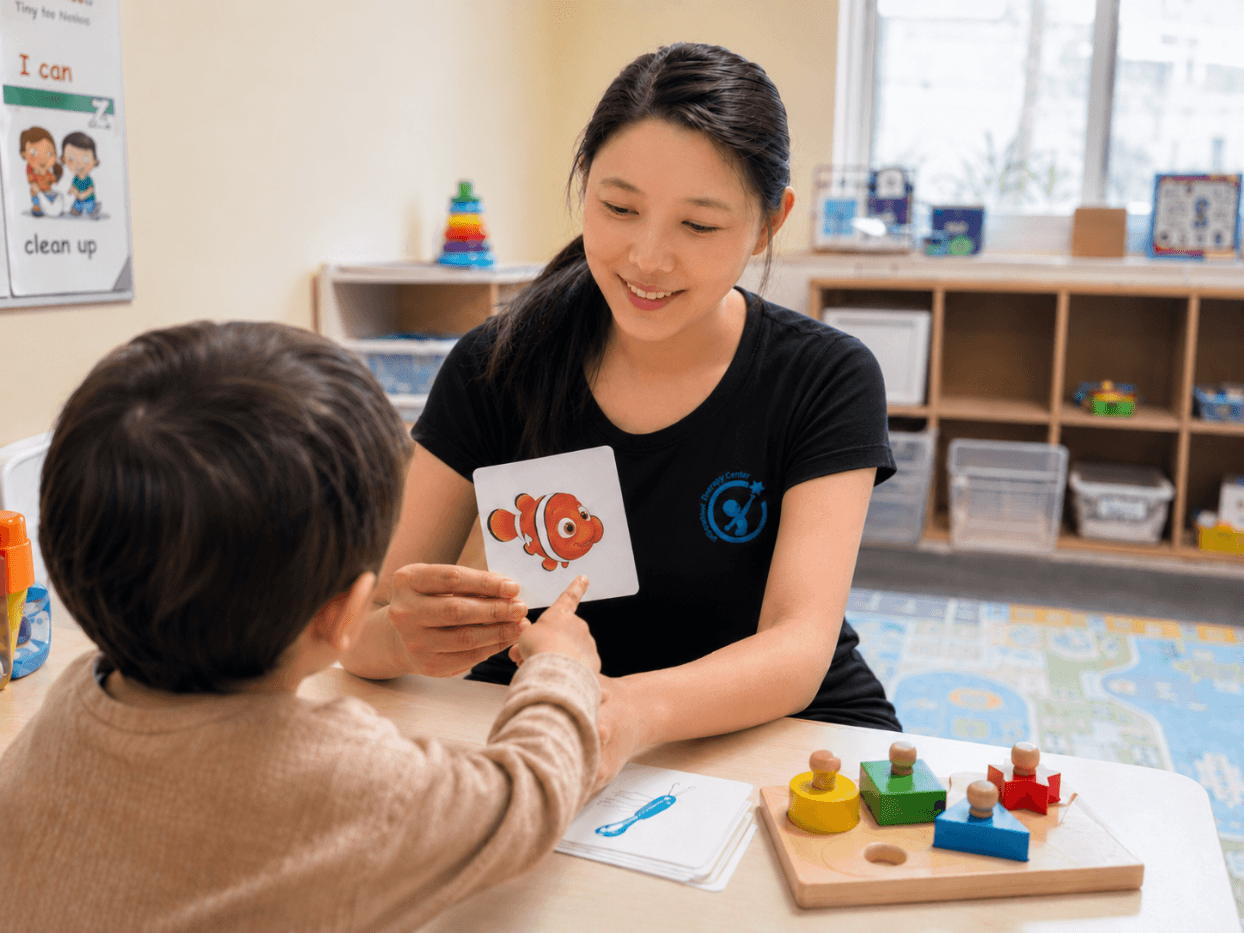
Appointment
Ready to book your first session?
We'd love to hear from you. Whether you have questions or you're ready to get started, just reach out — we're here to help.